If you’ve been shocked by your January ComEd or Nicor bill, it may be time to address why your energy usage is higher than expected. For homeowners with heat pumps, your home comfort system could be to blame. While heat pumps are extremely efficient, they have a “balance point” at which the extreme Chicago cold forces them to switch to less-efficient backup modes.
If your heat pump is struggling in the cold, you aren’t alone. Read on to hear from the team at Home Comfort as to why this happens and how to improve your system’s efficiency.
The Costly Switch to Auxiliary or Emergency Heat
Heat pumps work to warm your home by transferring heat from the outdoors into your home. When the system can no longer pull enough ambient warmth from the frigid outside air, it transitions to electric resistance “Auxiliary Heat.” As a result, homeowners may experience the “toaster effect,” as these heating elements consume significantly more electricity, causing bills to spike.
Defrost Cycles: Necessary but Energy Intensive
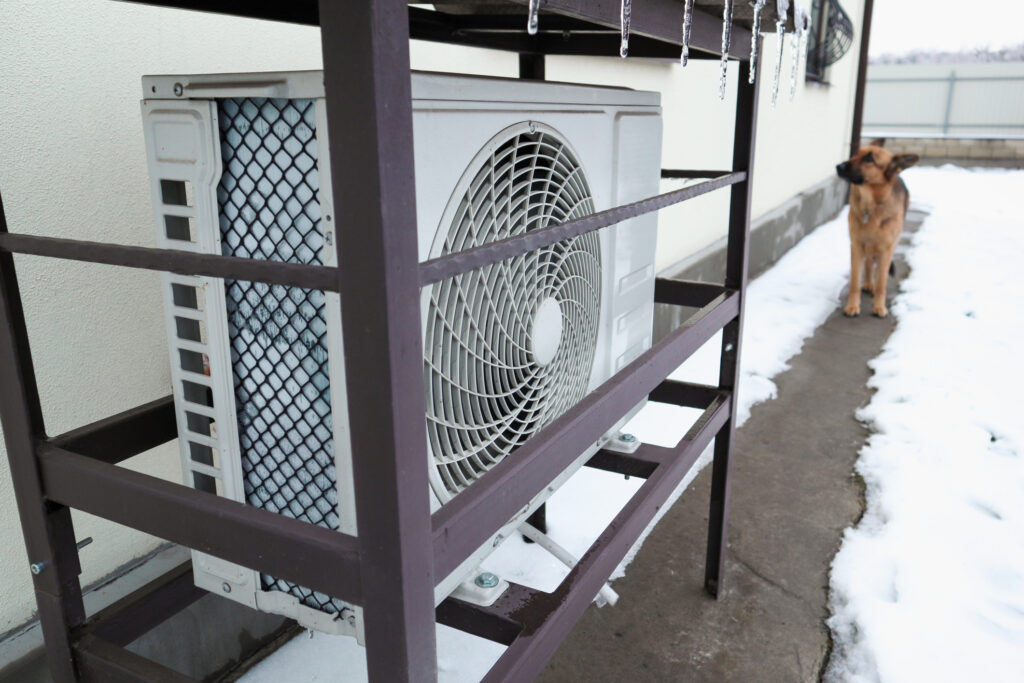
Another reason heat pumps consume more energy in the winter is the need for defrost cycles. The system must regularly melt ice off the outdoor coils during humid, snowy Chicagoland winters. If the system is stuck in a constant defrost loop due to a sensor failure, it effectively stops heating your home while continuing to draw massive power.
Mechanical Fatigue and Lack of Maintenance
Maintenance issues can also reduce efficiency. A dirty outdoor unit or clogged indoor filter forces the compressor to run longer and hotter to meet the thermostat’s demand. As a result, the system is in constant operation, which not only drives up bills, but also shortens the lifespan of the most expensive components in the system.
The Chicagoland Winter Factor: Survival in the Windy City
Many local homes in Park Ridge or Niles require a perfectly calibrated “Dual Fuel” system to handle Lake Michigan’s wind chill. Luckily, Home Comfort has the experience to optimize hybrid systems that ensure you aren’t paying for electric heat when gas is more efficient. This keeps energy bills low without compromising on comfort.
When to Call for a Professional Efficiency Audit
If your energy bills are 20-30% higher than the same month last year, it may be time for a professional heating system evaluation. Call Home Comfort and one of our licensed technicians will identify if the spike is a simple setting issue or a sign of an impending compressor failure. Then, we can recommend solutions that protect your home and your wallet.
Call Home Comfort Today
In Chicago, an energy spike is a “check engine light” for your heat pump. That’s why Home Comfort is here with comprehensive care for your system. Our team will get to the bottom of your skyrocketing bills to ensure that your system is working as efficiently as possible. Plus, if you’d benefit from a dual fuel system, we offer expert installation and upfront pricing.
Schedule a heating system evaluation with Home Comfort today to restore efficiency.
FAQ
Is It Normal For My Heat Pump To Run All Day?
Your heat pump shouldn’t run constantly, but it will run long, low-energy cycles. If you notice that the system is struggling to provide sufficient heat, it may be experiencing high-energy struggles.
Can A Smart Thermostat Lower My Winter Bills?
A smart thermostat can help with winter bills by ensuring heat pump optimization. Often, costs rise when a heat pump has to make a large temperature jump. With a smart thermostat, the system can make sure these large temperature swings don’t occur to prevent the auxiliary heat from turning on.
At about 25-30°F, heat pump efficiency tends to drop-off. If you have a dual fuel system, this is when your gas furnace kicks in to provide reliable warmth.
Is It Normal For My Heat Pump To Run All Day?
Your heat pump shouldn’t run constantly, but it will run long, low-energy cycles. If you notice that the system is struggling to provide sufficient heat, it may be experiencing high-energy struggles.
Can A Smart Thermostat Lower My Winter Bills?
A smart thermostat can help with winter bills by ensuring heat pump optimization. Often, costs rise when a heat pump has to make a large temperature jump. With a smart thermostat, the system can make sure these large temperature swings don’t occur to prevent the auxiliary heat from turning on.
At about 25-30°F, heat pump efficiency tends to drop-off. If you have a dual fuel system, this is when your gas furnace kicks in to provide reliable warmth.